Waste Segregation Plant Process: A Complete Guide to Modern Municipal Solid Waste Management
Waste Segregation Plant Process: A Complete Guide to Modern Municipal Solid Waste Management
Every city generates thousands of tonnes of municipal solid waste (MSW) every day. As urban populations grow, the volume of waste produced by households, commercial establishments, institutions, markets, hotels, hospitals, airports, and industries also continues to increase. Without an efficient system for handling this waste, cities face overflowing landfills, environmental pollution, public health risks, and rising waste management costs.
This is where the Waste Segregation Plant Process becomes one of the most critical stages in modern waste management.
A Waste Segregation Plant is designed to scientifically separate mixed municipal solid waste into different recyclable and reusable fractions. Instead of sending all collected waste directly to a landfill, the plant recovers valuable materials such as plastics, paper, cardboard, metals, glass, and organic waste. These recovered materials can then be recycled, composted, converted into Refuse Derived Fuel (RDF), or reused in various industries.
Modern waste segregation plants play a significant role in supporting the principles of the circular economy by transforming waste into valuable resources. Rather than treating waste as a disposal problem, advanced segregation facilities view it as a source of recyclable materials, renewable energy, and compost.
For municipal corporations, smart cities, industrial townships, airports, universities, and large residential communities, an efficient segregation plant is the backbone of sustainable waste management. It helps reduce landfill dependency, lowers greenhouse gas emissions, conserves natural resources, and improves operational efficiency.
In this comprehensive guide, you will learn:
What is a Waste Segregation Plant?
How does the Waste Segregation Plant Process work?
Why waste segregation is important
Types of waste processed
Major equipment used in segregation plants
Benefits of modern Material Recovery Facilities (MRFs)
Applications of 50–100 TPD segregation plants
Best practices for improving recycling efficiency
Whether you are a municipal officer, environmental consultant, waste management professional, student, industry expert, or simply interested in sustainable waste management, this guide provides a complete overview of the waste segregation process used in modern municipal solid waste management systems.


What is a Waste Segregation Plant?
A Waste Segregation Plant is a scientifically designed facility where mixed municipal solid waste is separated into different categories based on material type, size, weight, density, and recyclability. The objective is to maximize resource recovery while minimizing the quantity of waste sent to landfills.
Instead of disposing of all waste together, the plant identifies and separates recyclable materials such as plastics, paper, cardboard, metals, and glass. Organic waste is diverted for composting or bio-methanation, while combustible materials can be processed into Refuse Derived Fuel (RDF). Only inert and non-recyclable residues are ultimately directed to a sanitary landfill.
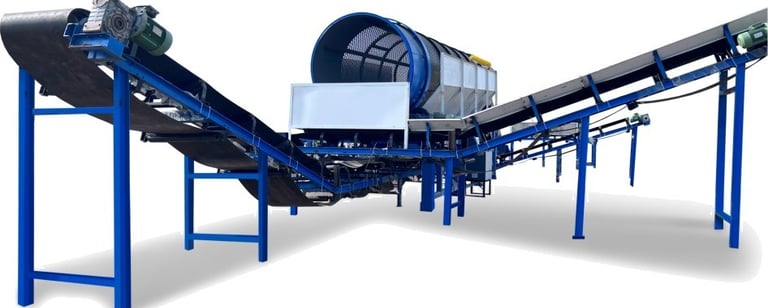
Modern segregation plants combine manual inspection with automated technologies to improve recovery rates. Typical systems include conveyors, bag openers, trommel screens, magnetic separators, air density separators, optical or sensor-based sorters (where applicable), and quality control stations.
The result is a structured, efficient process that supports environmental compliance, resource conservation, and sustainable waste management.
Why is Waste Segregation Important?
Waste segregation is the foundation of every successful municipal solid waste management system. Without proper segregation, recyclable materials become contaminated, organic waste cannot be composted effectively, and large quantities of valuable resources are lost to landfills.
The importance of segregation extends beyond waste handling—it directly influences environmental protection, public health, operational efficiency, and the economic viability of recycling.
1. Reduces Landfill Dependency
One of the biggest challenges faced by urban local bodies is the shortage of landfill space. By recovering recyclable materials and processing organic waste separately, segregation plants significantly reduce the amount of waste requiring final disposal.
Many modern facilities can divert a substantial portion of incoming waste away from landfills through recycling, composting, and RDF production, extending landfill life and reducing future infrastructure costs.
2. Improves Recycling Efficiency
Cleanly separated materials such as PET bottles, HDPE containers, cardboard, paper, ferrous metals, aluminium, and glass have much higher recycling value than mixed waste. Proper segregation increases recovery quality, making recycled materials more suitable for industrial reuse.
Higher-quality recyclables also generate better market value, helping improve the financial sustainability of waste management operations.
3. Supports Compost Production
Organic waste—including food waste, vegetable residues, garden waste, and biodegradable materials—can be processed into nutrient-rich compost when separated efficiently.
Quality compost supports agriculture, landscaping, horticulture, and soil restoration while reducing dependence on chemical fertilizers.
4. Enables RDF Production
Combustible dry waste such as multilayer plastics, textiles, paper residues, and other high-calorific materials can be processed into Refuse Derived Fuel (RDF).
RDF serves as an alternative fuel in industries such as cement manufacturing, helping reduce fossil fuel consumption and supporting waste-to-resource initiatives.
5. Protects the Environment
Scientific segregation helps reduce open dumping and uncontrolled burning of waste. This leads to lower air pollution, reduced soil contamination, improved groundwater protection, and better management of leachate and odour.
Efficient waste processing also contributes to lowering greenhouse gas emissions by reducing methane generation from unmanaged landfill sites.
6. Conserves Natural Resources
Every kilogram of paper, plastic, metal, or glass recovered through segregation reduces the demand for virgin raw materials. Recycling conserves energy, lowers industrial resource extraction, and promotes responsible resource utilization.
This aligns with global sustainability goals and strengthens the circular economy.
7. Enhances Public Health
Poorly managed mixed waste attracts pests, insects, rodents, and disease vectors. Scientific segregation minimizes these risks by ensuring faster processing, cleaner facilities, and safer handling of municipal waste.
Communities benefit from improved sanitation, reduced foul odours, and a healthier urban environment.
8. Supports Regulatory Compliance
Many countries, including India, have introduced regulations encouraging or mandating source segregation and scientific processing of municipal solid waste.
Well-designed segregation plants help local authorities meet statutory requirements, improve environmental performance, and support long-term waste management planning.
9. Creates Employment Opportunities
Waste segregation plants generate direct and indirect employment across multiple functions, including collection, transportation, sorting, equipment operation, maintenance, recycling logistics, compost marketing, and quality control.
As recycling industries expand, segregation infrastructure also contributes to green job creation.
10. Strengthens the Circular Economy
A modern segregation plant transforms waste from a disposal burden into a valuable resource stream.
Recovered plastics become recycled products, paper is reprocessed into new packaging, metals are melted and reused, organic waste becomes compost, and combustible fractions are converted into RDF. This closed-loop approach reduces waste generation while maximizing resource efficiency.
Waste Segregation: The First Step Toward Sustainable Waste Management
A successful waste management system begins with segregation. Whether the waste originates from households, commercial establishments, institutions, airports, markets, hotels, or industries, the ability to separate materials into useful fractions determines the overall efficiency of the entire waste processing chain.
In a typical 50–100 TPD Waste Segregation Plant, incoming municipal solid waste is received at a designated tipping floor, inspected, and transferred through a series of mechanical and manual sorting stages. Each stage is designed to recover maximum value while minimizing contamination.
The recovered materials are then directed to dedicated processing streams such as recycling, composting, RDF preparation, or safe disposal. This systematic approach not only improves operational efficiency but also helps municipalities reduce landfill dependency, lower waste management costs, and move toward a zero-waste future.
Ultimately, waste segregation is more than just sorting materials—it is the foundation of sustainable cities, resource conservation, and environmentally responsible developme
Waste Segregation Plant Process: Step-by-Step Workflow (50–100 TPD Plant)
The efficiency of any Waste Segregation Plant depends on a systematic workflow that ensures maximum recovery of recyclable materials while minimizing waste sent to landfills. A modern 50–100 TPD Municipal Solid Waste (MSW) Segregation Plant combines mechanical equipment with manual quality inspection to process mixed waste safely and efficiently.
The objective of the process is to recover valuable resources, produce compost from biodegradable waste, generate Refuse Derived Fuel (RDF) from combustible materials, and send only inert rejects to a scientific landfill.


Step 1 – Municipal Waste Collection
The process begins with the collection of mixed municipal solid waste from households, commercial establishments, markets, institutions, hotels, public places, and other waste generation points.
Waste is transported to the segregation facility using:
Compactor Trucks
Tipper Vehicles
Dumper Placers
Auto Tippers
Hook Loader Containers
Purpose
Centralized waste processing
Controlled transportation
Reduced littering
Improved collection efficiency
Step 2 – Weighbridge & Vehicle Inspection
Before unloading, each incoming vehicle passes through a Weighbridge.
Objectives
Record vehicle weight
Calculate daily waste quantity
Track operational performance
Maintain municipal records
Improve billing and reporting
Data collected includes:
Vehicle Number
Collection Zone
Time of Arrival
Gross Weight
Net Waste Weight
Step 3 – Waste Reception / Tipping Floor
Collected waste is unloaded on a specially designed Tipping Floor.
The tipping floor acts as a temporary storage and inspection area where operators visually assess the incoming waste.
Inspection checks include:
Excess moisture
Hazardous materials
Biomedical waste
Bulky waste
Large stones
Concrete pieces
Tree trunks
Removing such materials at an early stage protects downstream machinery from damage.
Step 4 – Feeding Hopper
The waste is loaded into a Feeding Hopper using loaders or excavators.
Function
The Feeding Hopper:
Stores incoming waste temporarily
Provides continuous feeding
Maintains uniform material flow
Prevents overloading
Reduces equipment downtime
A controlled feed rate improves the efficiency of the entire plant.
Step 5 – Bag Opening System
Municipal waste often arrives inside plastic bags.
The Bag Opener automatically tears open waste bags without excessively shredding the contents.
Advantages
Better waste exposure
Improved sorting efficiency
Reduced manual labour
Faster downstream processing
Lower contamination levels
This stage significantly increases material recovery.
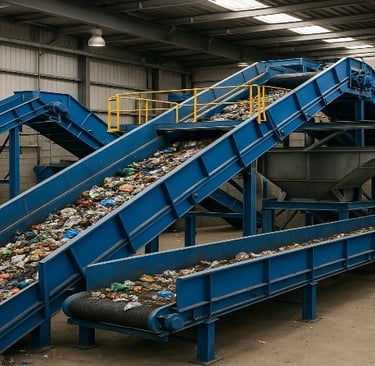
Step 6 – Primary Conveyor System
Once bags are opened, waste is transferred using a Primary Conveyor Belt.
The conveyor transports waste through different processing stations.
Conveyor Benefits
Continuous material movement
Reduced manual handling
Higher productivity
Lower operational cost
Improved worker safety
Typical conveyor components include:
Belt
Drive Motor
Gearbox
Rollers
Idlers
Belt Scraper
Emergency Pull Cord
Side Guards
Step 7 – Manual Pre-Sorting
Before mechanical separation begins, trained operators remove oversized and unsuitable materials.
Items commonly removed include:
Large plastic sheets
Wooden logs
Tyres
Fabric rolls
Furniture pieces
Electronic waste
Batteries
Gas cylinders
Hazardous materials
Importance
Manual pre-sorting protects expensive machinery such as Trommel Screens and Air Density Separators from damage.
Step 8 – Trommel Screening
The Trommel Screen is one of the most important machines in a waste segregation plant.
It is a rotating cylindrical drum fitted with perforated screens that separate waste based on particle size.
Typical Separation
Fine Fraction (0–80 mm)
Contains:
Organic waste
Soil
Compostable material
Sand
Small particles
Fine material is generally sent for:
Composting
Bio-mining
Soil recovery
Oversized Fraction (>80 mm)
Contains:
Plastic
Cloth
Rubber
Paper
Cardboard
Metals
Glass
RDF material
This fraction moves to the next stage for further recovery.
Advantages of Trommel Screening
High throughput
Uniform screening
Better material separation
Lower manual sorting requirement
Increased recycling efficiency
Step 9 – Magnetic Separation
The oversized waste passes through a Magnetic Separator.
Function
The machine removes ferrous metals using a powerful suspended magnet.
Recovered materials include:
Iron
Steel
Tin Cans
Metal Scraps
Nails
Wires
Benefits
Protects downstream equipment
Generates recyclable scrap
Reduces machine wear
Improves RDF quality
Recovered metals are sold to authorized recycling industries.
Step 10 – Air Density Separation
After magnetic separation, the material enters the Air Density Separator (ADS).
The ADS separates materials based on density using controlled airflow.
Light Fraction
Examples:
Plastic Film
LDPE
Multilayer Plastic
Paper
Textile
Dry Leaves
These materials are suitable for:
RDF production
Plastic recycling
Heavy Fraction
Examples:
Stones
Glass
Bricks
Ceramic
Heavy Plastic
Metal Pieces
These materials are directed to recycling or inert disposal.
Advantages
High recovery efficiency
Better RDF quality
Lower contamination
Reduced manual sorting
Step 11 – Manual Quality Sorting
After mechanical separation, trained workers perform final quality inspection.
They segregate materials into dedicated categories:
PET Bottles
HDPE
PP Plastic
Cardboard
White Paper
Mixed Paper
Aluminium
Copper
Ferrous Metal
Glass
Rubber
Textile
Quality sorting increases the resale value of recyclable materials and reduces contamination.
Step 12 – Organic Waste Processing
The fine organic fraction is transferred to the organic waste treatment section.
Depending on the project requirements, the material may undergo:
Windrow Composting
Aerobic Composting
In-Vessel Composting
Biomethanation
The end products include:
Organic Compost
Soil Conditioner
Biogas (where applicable)
Proper processing converts biodegradable waste into useful products instead of generating methane in landfills.
Step 13 – Plastic Recovery
Recovered plastic materials are sorted according to polymer type.
Common categories include:
PET
HDPE
LDPE
PP
Mixed Plastic
Multilayer Plastic
Depending on quality, plastics are:
Baled for recycling
Shredded
Converted into RDF (for non-recyclable fractions)
Step 14 – Paper & Cardboard Recovery
Recovered paper products include:
Newspapers
Corrugated Boxes
Office Paper
Kraft Paper
Cardboard
These materials are compressed into bales and supplied to paper recycling industries.
Step 15 – Metal Recovery
Both ferrous and non-ferrous metals are recovered.
Recovered metals include:
Steel
Iron
Aluminium
Copper
Brass
Metal recycling saves significant energy compared to primary metal production.
Step 16 – Glass Recovery
Glass bottles and containers are separated manually after the primary mechanical stages.
Recovered glass is cleaned and supplied to recycling facilities where it is melted and converted into new products.
Step 17 – RDF Preparation
Combustible materials with high calorific value are processed into Refuse Derived Fuel (RDF).
Suitable materials include:
Textile
Paper Residues
Plastic Film
Laminated Packaging
Rubber
Foam
The RDF preparation process generally includes:
Drying (if required)
Secondary Shredding
Screening
Quality Inspection
Storage
The final RDF is widely used as an alternative fuel in cement plants and selected industrial applications.
Step 18 – Baling, Storage & Dispatch
Recovered recyclable materials are compressed using a Horizontal Baler Machine.
Benefits of Baling
Reduces storage space
Lowers transportation costs
Improves handling efficiency
Increases market value of recyclables
Simplifies inventory management
Finished bales are labelled, stored in dedicated areas, and dispatched to authorized recyclers, compost users, or RDF consumers.






50–100 TPD Waste Segregation Plant: Benefits, Applications, Best Practices & FAQs
A 50–100 TPD Waste Segregation Plant is an ideal solution for medium-sized municipalities, industrial townships, airports, smart cities, and large institutional campuses. With increasing pressure to reduce landfill dependency and improve recycling rates, these facilities play a critical role in modern Municipal Solid Waste Management (MSWM).
By combining scientific waste segregation with recycling, composting, and RDF production, a modern Material Recovery Facility (MRF) helps recover valuable resources while significantly reducing environmental impact.
Benefits of a Waste Segregation Plant
A well-designed waste segregation plant offers environmental, operational, financial, and social benefits.
1. Maximum Resource Recovery
Instead of disposing of mixed waste directly into landfills, the plant recovers recyclable materials such as:
PET Bottle, HDPE, LDPE, Paper, Cardboard, Glass, Steel, Aluminium, Copper, Organic Waste
Recovered materials can be sold to recycling industries, creating an additional revenue stream while conserving natural resources.
2. Significant Reduction in Landfill Waste
One of the primary objectives of a segregation plant is to minimize the quantity of waste requiring landfill disposal.
A properly operated 50–100 TPD Waste Segregation Plant can divert a large portion of incoming waste toward recycling, composting, or RDF production. This extends landfill life, reduces transportation costs, and lowers long-term environmental liabilities.
3. Improved Recycling Efficiency
Scientific segregation produces cleaner recyclable fractions with lower contamination levels.
This improves:
Material quality
Recycling efficiency
Market value
Buyer confidence
Processing speed
Higher-quality recyclables command better prices in the recycling market.
4. Compost Production from Organic Waste
Biodegradable waste recovered during segregation can be processed into nutrient-rich compost through windrow composting, aerobic composting, or in-vessel systems.
Benefits include:
Improved soil fertility
Reduced chemical fertilizer usage
Sustainable agriculture support
Diversion of organic waste from landfills
5. RDF Generation
High-calorific combustible materials are converted into Refuse Derived Fuel (RDF), which can be used as an alternative fuel in cement plants and selected industrial applications.
Advantages:
Reduced fossil fuel consumption
Energy recovery from waste
Better utilization of non-recyclable dry waste
Lower landfill burden
6. Environmental Protection
Scientific segregation reduces:
Open dumping
Waste burning
Air pollution
Soil contamination
Groundwater pollution
Methane emissions
Odour issues
This contributes to cleaner cities and improved public health.
7. Employment Generation
Waste segregation facilities create employment opportunities for:
Plant Operators
Machine Operators
Sorting Staff
Supervisors
Maintenance Engineers
Electricians
Safety Officers
Quality Inspectors
Logistics Teams
The recycling ecosystem also supports indirect employment in transportation, processing, and manufacturing.
8. Supports Circular Economy
Recovered materials are returned to the production cycle instead of becoming waste.
Examples include:
Plastic → New Plastic Products
Paper → Recycled Paper
Glass → New Glass Containers
Metals → Industrial Raw Materials
Organic Waste → Compost
Combustible Waste → RDF
This reduces the extraction of virgin resources and promotes sustainable development.
Recommended Plant Capacity (50–100 TPD)
A 50–100 TPD Waste Segregation Plant is suitable for:
Municipal Councils
Municipal Corporations
Smart Cities
Airport Authorities
Industrial Parks
Educational Campuses
Defence Establishments
Tourism Zones
Integrated Townships
Large Residential Projects
Typical daily processing:
50 TPD Plant: ~50 metric tonnes/day
100 TPD Plant: ~100 metric tonnes/day
Actual output depends on waste composition, moisture content, source segregation, and operating efficiency.
Applications of Waste Segregation Plants
Municipal Corporations
Urban local bodies process large quantities of municipal waste every day. Segregation plants improve recycling efficiency and help meet waste management targets.
Smart Cities
Smart city projects require scientific waste processing systems that reduce landfill dependency and improve resource recovery.
Airport Waste Management
Airports generate diverse waste streams, including food waste, packaging materials, paper, plastics, and garden waste. Dedicated segregation plants improve operational efficiency and environmental compliance.
Industrial Townships
Industrial parks and manufacturing zones use segregation plants to recover recyclables and reduce disposal costs.
Educational Institutions
Universities and large campuses generate significant quantities of biodegradable and recyclable waste that can be processed sustainably.
Residential Townships
Integrated residential projects benefit from on-site segregation, reducing transportation costs and promoting community-level waste management.
Common Challenges in Waste Segregation
Even with advanced machinery, waste segregation plants face several operational challenges:
Mixed waste due to poor source segregation
High moisture content during monsoon
Contamination of recyclables
Seasonal variation in waste composition
Odour generation
Dust emissions
Equipment wear and tear
Inadequate worker training
Fluctuating recyclables market prices
Limited public awareness
Addressing these issues requires proper planning, preventive maintenance, and continuous public participation.
Best Practices for Efficient Waste Segregation
To achieve maximum recovery and plant efficiency:
Promote source segregation at households and commercial establishments.
Ensure regular preventive maintenance of machinery.
Calibrate equipment periodically for consistent performance.
Provide proper personal protective equipment (PPE) to workers.
Install dust suppression and odour control systems.
Monitor recovery rates through regular data analysis.
Maintain clean storage areas for recovered materials.
Train operators on safe equipment handling.
Conduct quality checks before dispatching recyclables.
Review plant performance using monthly operational reports.
Frequently Asked Questions (FAQ)
What is a Waste Segregation Plant?
A Waste Segregation Plant is a facility that separates mixed municipal solid waste into recyclable, biodegradable, combustible, and inert fractions using manual and mechanical processes.
How does a Waste Segregation Plant work?
Waste is collected, unloaded, fed through conveyors, screened using a trommel, separated using magnetic and air density systems, manually sorted, and then directed to recycling, composting, RDF production, or landfill.
What is the purpose of waste segregation?
Waste segregation improves recycling efficiency, reduces landfill dependency, conserves natural resources, and supports sustainable waste management.
What is an MRF Plant?
A Material Recovery Facility (MRF) is a specialized waste processing plant that recovers recyclable materials such as plastics, paper, cardboard, metals, and glass from mixed waste streams.
What equipment is used in a Waste Segregation Plant?
Common equipment includes:
Feeding Hopper
Conveyor Belt
Bag Opener
Trommel Screen
Magnetic Separator
Air Density Separator
Manual Sorting Conveyor
Shredder
Horizontal Baler
What is RDF?
Refuse Derived Fuel (RDF) is a processed fuel produced from high-calorific combustible waste such as plastics, textiles, and paper residues. It is widely used in cement plants as an alternative fuel.
Can mixed municipal waste be processed?
Yes. Modern segregation plants are specifically designed to process mixed municipal solid waste. However, source segregation improves recovery efficiency and material quality.
What is the ideal capacity for a municipal segregation plant?
The ideal capacity depends on the quantity of waste generated. A 50–100 TPD Waste Segregation Plant is suitable for medium-sized municipalities, industrial townships, and airport facilities.
Why is waste segregation important before recycling?
Proper segregation prevents contamination, improves the quality of recyclable materials, and increases the efficiency of recycling operations.
How does a segregation plant support sustainability?
By recovering reusable materials, producing compost, generating RDF, and reducing landfill disposal, segregation plants contribute to a circular economy and help conserve natural resources.
Conclusion
A modern Waste Segregation Plant is no longer just a waste processing facility—it is the foundation of an efficient, sustainable, and resource-oriented waste management system.
For municipalities, airports, industrial parks, and smart cities, scientific segregation offers a practical solution to reduce landfill dependency, recover valuable recyclables, produce compost, and generate alternative fuels such as RDF. By integrating advanced equipment like trommel screens, magnetic separators, air density separators, conveyors, shredders, and balers, these facilities maximize recovery while improving operational efficiency.
As waste generation continues to grow, investing in a well-planned 50–100 TPD Waste Segregation Plant is a strategic step toward cleaner cities, environmental compliance, and long-term sustainability.
Call to Action
Looking for a reliable Waste Segregation Plant Manufacturer in India?
Whether you are planning a 50 TPD or 100 TPD Municipal Solid Waste Processing Plant, a modern Material Recovery Facility (MRF), or a complete Integrated Waste Management Solution, choosing the right technology and engineering partner is essential.
Key factors to consider include:
Customized plant design based on waste characteristics
High-efficiency segregation equipment
Reliable operation and maintenance support
Compliance with applicable waste management regulations
Scalable solutions for future expansion
A professionally designed segregation plant helps maximize resource recovery, reduce operational costs, and support long-term environmental goals.
PHONE:-
+91 96370 01919
+91 94051 70239
+91 87999 26002
EMAIL:-
marketing@hindzerowaste.com
info@hindzerowaste.com
sales@hindzerowaste.com
Copyright © 2024 hindzerowaste | Website Developed By Dhiraj Charane
OUR PRODUCT:
OUR ADDRESS
Hind Group, H406, Fourth Floor, Govind Excellency, 6th Lane, Rajarampuri. Kolhapur 416008, Maharashtra, India