Zero Landfill Solution & 120 TPD MSW Plant Capacity
Zero Landfill Solution & 120 TPD MSW Plant Capacity: The Future of Sustainable Waste Management
Introduction
In today’s rapidly urbanizing world, municipal solid waste (MSW) has become one of the most critical environmental challenges. Cities generate thousands of tonnes of waste daily, and traditional dumping methods are no longer sustainable. This is where the concept of a Zero Landfill Solution integrated with a 120 TPD (Tonnes Per Day) MSW Plant Capacity becomes a game-changer.
This advanced waste management approach focuses on maximum resource recovery, minimal landfill dependency, and complete waste processing through scientific treatment technologies.
What is a Zero Landfill Solution?
A Zero Landfill Solution refers to a comprehensive waste management system where almost 100% of collected municipal solid waste is processed, recycled, or converted into useful outputs, leaving no waste for landfill disposal.
Key Objectives:
Eliminate dependency on landfills
Achieve maximum material recovery
Convert waste into reusable resources
Reduce environmental pollution
Support circular economy model
How It Works:
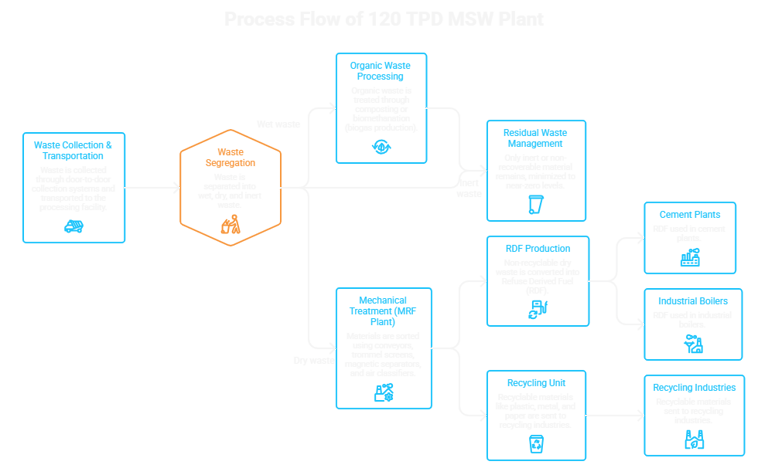
Instead of dumping waste, it is processed through:
Segregation at source
Mechanical sorting (MRF systems)
Organic waste composting / biomethanation
RDF (Refuse Derived Fuel) production
Recycling of plastics, metals, and inert materials
Understanding 120 TPD MSW Plant Capacity
A 120 TPD MSW plant is designed to process 120 tonnes of municipal solid waste per day efficiently using integrated waste treatment technologies.
What 120 TPD Means:
120 tonnes of waste handled daily
Suitable for medium to large urban municipalities
Continuous operation (8–16 hours/day depending on design)
Multi-stream processing system
Technologies Used in 120 TPD MSW Plant
A modern zero landfill system uses advanced machinery such as:
Trommel Screen
Shredder Machine
Ballistic Separator
Magnetic Separator
Wind Sifter
Conveyor Systems
Bailing Press Machines
Composting Systems
These technologies ensure high efficiency, automation, and resource recovery.
Benefits of Zero Landfill MSW Plant
Environmental Benefits
Reduces landfill overflow
Minimizes soil and groundwater contamination
Reduces greenhouse gas emissions
Promotes cleaner cities
Economic Benefits
Revenue from recyclables
RDF sales to industries
Compost marketing
Job creation in waste sector
Social Benefits
Cleaner urban environment
Improved public health
Increased awareness about segregation
Why 120 TPD Capacity is Ideal for Cities
A 120 TPD plant is strategically suitable because:
It matches waste generation of medium cities
Easier operational control
Cost-effective infrastructure
Scalable design for future expansion
Balanced CAPEX and OPEX
Zero Landfill Strategy: The Future of Smart Cities
Governments and municipalities are shifting towards smart waste management systems where landfill dependency is eliminated. The integration of:
Smart segregation
Automated processing plants
Resource recovery systems
ensures cities move towards sustainable and circular waste economies.
A Zero Landfill Solution combined with a 120 TPD MSW Plant is not just a waste management system it is a complete environmental transformation model. It converts waste from a burden into a resource, supports sustainable development, and aligns with India’s long-term urban sustainability goals.
Cities adopting this model will lead the future of clean, green, and smart urban development.
PHONE:-
+91 96370 01919
+91 94051 70239
+91 87999 26002
EMAIL:-
marketing@hindzerowaste.com
info@hindzerowaste.com
sales@hindzerowaste.com
Copyright © 2024 hindzerowaste | Website Developed By Dhiraj Charane
OUR PRODUCT:
OUR ADDRESS
Hind Group, H406, Fourth Floor, Govind Excellency, 6th Lane, Rajarampuri. Kolhapur 416008, Maharashtra, India